
How Surgery Affects a Child’s Vision
Surgeries like hemispherectomy, occipital lobectomy, and TPO disconnection (also called posterior quadrantic disconnection) involve removing or disconnecting parts of the brain that control vision — especially the occipital lobe. As a result, these procedures can change how a child sees the world.
Some of these vision changes are permanent and will affect how a child processes visual information for the rest of their life. In this section, we’ll explain how vision works, what changes to expect after surgery, and how these challenges can impact daily life – especially at home and in the classroom. Most children will need some support at school to help them succeed with their new visual abilities.
A Note of Hope: Kids Are Remarkably Adaptable
While the vision changes after surgery can sound overwhelming, most children adapt very well – especially over time and with the right supports. With patience, practice, and thoughtful adjustments at home and school, many kids go on to thrive socially, academically, and emotionally.
You are not alone in this. There are clear steps you can take to help your child succeed and we’re here to walk with you through every part of the journey.
Common Vision Changes After Hemispherectomy, Occipital Lobectomy, or TPO Disconnection
-
Loss of half the visual field (homonymous hemianopia): The child will not see anything on one side (left or right) in both eyes. For example, they might not notice things or people on their right side, even though both eyes appear healthy.
-
Bumping into objects or people on the side with vision loss, especially in crowded or unfamiliar spaces.
-
Difficulty reading or tracking lines of text, depending on which part of the visual field is affected.
-
Challenges with depth perception, such as judging how far away something is or stepping off curbs or stairs.
-
Missing visual cues — like facial expressions, raised hands, or body language — during conversations or class activities.
-
Struggles with hand-eye coordination, which can make activities like handwriting, drawing, and playing sports more difficult.
-
Visual fatigue, especially in busy or fast-moving environments, as the brain works harder to fill in missing information.
Learn More: In-Depth Guides for Caregivers
Explore these detailed pages to better understand and support your child’s needs after surgery:
-
What Is Homonymous Hemianopia?
Learn what it really means to lose half your visual field, and how to help your child adapt.
➡️ Read More -
Reading & School Challenges After Surgery
How vision loss affects reading, writing, and classroom learning — and what accommodations really help. -
Helping with Depth Perception & Mobility
Tips for keeping your child safe and confident when moving through the world with changed vision. -
Vision Fatigue & Cognitive Load
Why kids may tire easily after surgery — and how to reduce visual strain. -
Emotional & Social Impacts of Vision Changes
How vision differences can affect self-esteem, friendships, and social development — plus ways to support resilience.
Vision After Hemispherectomy, TPO Disconnection, and Occipital Lobectomy
This guide summarizes the various visual impairments a child will have after hemispherectomy, TPO disconnection, and occipital lobectomy, and how they can affect a child’s daily living, functional mobility, and access to the educational curriculum in school.
Helpful Educational Strategies For Children With Homonymous Hemianopia
This quick guide provides you with strategies that can be used to help the child in school.
🎥 Webinar – Vision After Surgeries Which Remove An Occipital Lobe
This webinar we gave for Perkins School of the Blind provides a detailed explanation of homonymous hemianopia, its effects on walking, driving, and reading, as well as tips for accommodations and teaching strategies.
What is vision?
Vision is the ability to assimilate information about the environment by the brain’s interpretation of the light that comes through the eyes. The eyes are the sensory organs that collect information; however, we “see” in the brain. Good vision is essential for a child’s development. It allows the child to differentiate letters and words, participate in sports, and navigate the environment.
It is commonly thought that more than 80% of a child’s learning comes from vision. Problems with vision can lead to movement or mobility challenges, as well as challenges with school and learning, and social and emotional difficulty.
How the typical brain sees
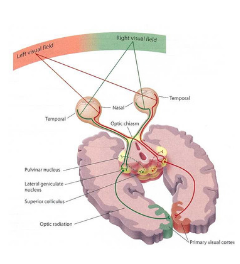
In typical individuals, the brain processes visual information that comes into both eyes. The eyes take a picture of an object, and that picture is then converted to electrical impulses which are sent to the brain first by way of the optic nerves which then connect to white matter tracts and fibers (also known as optic radiations) that eventually connect to the occipital lobes of the brain.
Vision is best understood as a combined function of the eyes, the eye muscles, and the brain. There are several different parts to vision. These include acuity, eye coordination, depth perception, focusing ability, peripheral awareness (also known as side vision), color vision, and visual perception and processing, which contribute to a child’s overall visual ability. How well each part of vision works, both alone and together, are important for how a child sees and interacts with the world.
Next – Acuity