

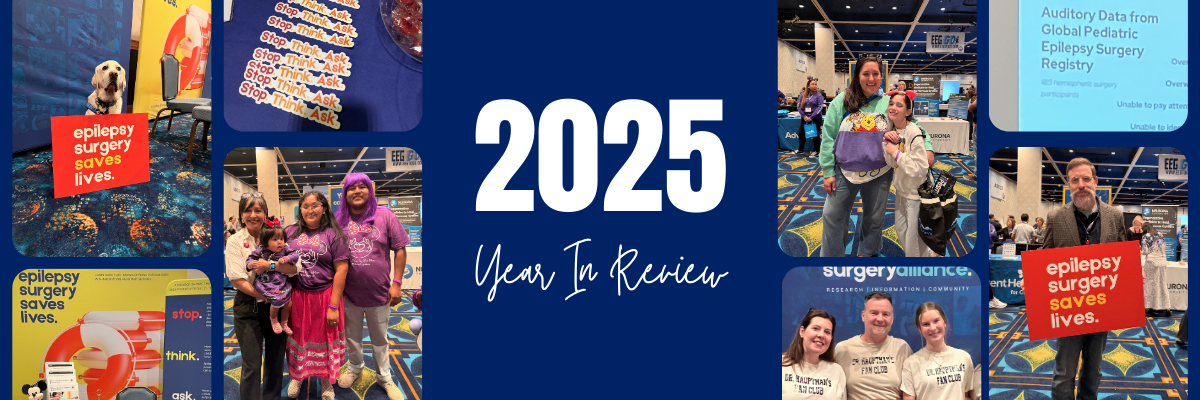
For us, 2025 was defined by five moments that, together, moved families closer to answers, support, and better outcomes.
1) We said the quiet part out loud: epilepsy surgery can save lives
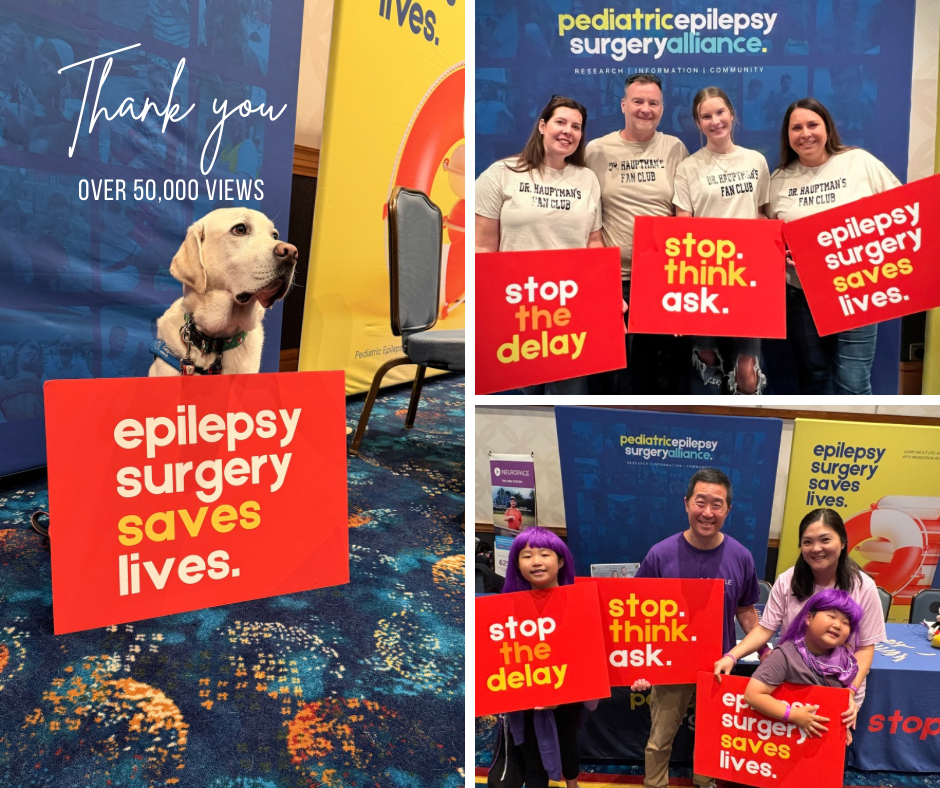
In 2025, we pushed hard on a message families deserve to hear early, not late: epilepsy surgery is not a “last resort,” and for many children with drug-resistant epilepsy, it can be life-saving. Our “Epilepsy Surgery Saves Lives” awareness campaign put clear, plain-language facts in front of parents and caregivers who are often drowning in fear and uncertainty.
This mattered because families cannot ask for a surgical evaluation if they do not know it exists, or if they have been taught to treat surgery as a last-ditch option. Getting informed sooner can change the entire trajectory.
The campaign is an ongoing message we share year-round on social media. So far, it has reached more than 50,000 different social media accounts. When this important information reaches that many people, it means tens of thousands of parents, relatives, and doctors are more likely to:
- Recognize the red flag: seizures that are not controlled by medication deserve a serious, timely conversation about next steps.
- Ask the right question earlier: “Should we get a referral for a surgical evaluation?” Earlier referrals can prevent months or years of uncontrolled seizures and the damage that can come with them.
- Feel less alone and less afraid: seeing clear, steady information from a trusted source helps families feel grounded enough to take action.
- Find real support: families often move from a post to our resources, webinars, and peer support, which can help them make decisions with better information and less panic
Check out our Instagram account to see the campaign in action.
2) We helped families get medical appointments that open doors
A surgical evaluation can mean multiple appointments, in-patient hospitalizations, time off work, travel, lodging, meals, and a pile of logistics on top of an already brutal season of life. In 2025, thanks to donors, we awarded over $42,000 in financial aid to families in need.
Our Dreams for Danny Surgical Evaluation Travel Scholarship exists for one reason: finances should never be the reason a child misses the evaluation that could change their future. The scholarship provides up to $1,000 in reimbursed travel costs for qualifying families.
3) We brought the “after surgery” conversation into schools
Surgery is not the finish line. For many kids, the next battle is school, learning, and development. In fact, research supports that school staff must be trained on the educational impacts of epilepsy surgery in order for children to thrive. When school teams are well-informed about the implications of epilepsy surgery, they can also educate the broader school community, including other students and parents. This education fosters empathy and understanding, reducing stigma and promoting a supportive environment that is essential for the child’s well-being.
“Training educators on the neurological and psychological effects of epilepsy surgery is essential for creating effective educational environments that support the child’s recovery and academic progress.”
In 2025, we trained 140 school staff in 16 states on the educational impacts children can face and what schools can do to support them. This mattered because families should not have to educate every teacher from scratch while they are also recovering from a major medical event. When school teams understand the child’s needs, kids have a better shot at learning.
4) We expanded peer support, because families need someone who “gets it”
There is a specific kind of loneliness that comes with drug-resistant seizures and major, irreversible brain surgery decisions. Research backs up what families tell us they feel: parents of children with drug-resistant epilepsy have significantly elevated stress even before surgery, and pediatric neurosurgery adds an undeniable layer of stress to the entire experience.
In fact, in one study, almost half of parents showed enough symptoms to warrant an actual PTSD diagnosis after their child’s neurosurgical procedure, far higher than the general population. And research shows that although stress may decrease after surgery, it often does not return to normal.
This is why our Parent Support Navigator Program matters. One of the most practical ways we fight that loneliness is by connecting a parent to someone who has lived this journey and can offer steady, informed peer support. Navigators help families feel less isolated, normalize trauma responses, and stay grounded through evaluation, surgery, and the long aftermath, including when seizure freedom is not guaranteed and stress persists. This is a trauma-informed layer of support that meets families where they are, not where everyone expects them to be.
In 2025, we continued to recruit and train navigators, with training that takes months because families deserve support that is thoughtful and responsible.

At the Pediatric State of the Art symposium, I discussed why it's important for all surgical options to be presented to families.
5) Bringing your real-life experiences to medical meetings
In 2025, we brought your lives into rooms where decisions are made. We gave presentations at major medical meetings, including the American Epilepsy Society and the American Academy of Audiology, to bring what you go through every day directly to the professionals influencing care, research, and policy.
At the American Academy of Audiology meeting, we spoke about how certain epilepsy surgeries can affect a child’s ability to hear and listen afterward, and why that matters in real life, not just on a hearing test. We focused on the functional and educational impact, including listening fatigue, classroom access, and the need for schools to understand and support changes in auditory processing and communication so children can learn and participate as fully as possible after surgery.
At the American Epilepsy Society meeting, we hosted a transition dinner focused on a problem that gets overlooked: what happens when kids who have had epilepsy surgery, complex imaging histories, shunts, or neuromodulation devices grow up and age out of pediatric systems. The dinner brought together clinicians, researchers, and advocates for a practical, no-fluff working conversation about how to make handoffs safer and smoother, including imaging continuity, referral relationships, and what “good” transfer packets should actually include so families are not forced to start over every time care changes hands.
We also spoke at the Pediatric State of the Art symposium as well as the psychosocial comorbidities special interest group meeting. At the Pediatric State of the Art Symposium, we made sure the family perspective was part of the “official” pediatric epilepsy conversation, not an afterthought. I spoke to an audience of clinicians and researchers about what families actually live through, the real-world barriers that delay surgical referrals, and what kids and caregivers need before, during, and long after epilepsy surgery. I focused on practical takeaways: treat the epilepsy surgery journey as a whole-family experience, communicate clearly and early about surgical evaluation, and build supports that extend past the operating room, including school planning, peer support, and tools families can use to make informed decisions.
At the Psychosocial Comorbidities session, we focused on the medical trauma that can come with having a child go through epilepsy surgery, and why that trauma matters for both children with drug-resistant epilepsy and their caregivers. We talked about how the stress starts long before the operating room, builds through the evaluation and hospitalization, and often continues long after surgery, shaping how families cope, make decisions, and engage with care. The takeaway was simple: if we want better outcomes, we cannot treat medical trauma as “extra.” Doctors should assume high stress is present, name it, and respond with a trauma-informed approach across the entire journey, including clear communication, realistic expectation-setting, and consistent supports for caregivers.
We also helped shape public-facing education by curating all epilepsy surgery speakers for Epilepsy Awareness Day at Disneyland, making sure families heard accurate, practical information about surgical options from the right experts, not vague reassurance or outdated myths.

Audrey Vernick, our Director of Patient and Family Advocy, discusses the importance of trauma-informed care
If you want to be part of what comes next
If you supported this work in 2025, thank you. You directly helped families move from fear to facts, from isolation to connection, and from delay to action.
If you want to help in 2026:
- There’s still time to donate
- Learn about our programs and resources for families.
- Apply for, or share, the travel scholarship
- Volunteer as a Parent Support Navigator
All my gratitude to our staff Audrey Vernick and Nicole Murray, without whom these milestones would not be possible, and to our incredible board of directors for their guidance and support.
Wishing you and yours a wonderful 2026!
about the author
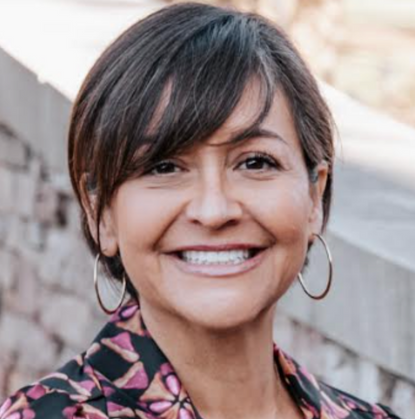
Monika Jones, an inactive lawyer, is our founder and executive director. Her first son, Henry, had a modified lateral hemispherotomy, revision surgery, then true anatomical hemispherectomy to stop seizures caused by total hemimegalencephaly. She is also the principal investigator of the Global Pediatric Epilepsy Surgery Registry, the only parent-reported data collection to understand the developmental trajectory after pediatric epilepsy surgery. A strong believer in collaboration, she serves on the Pediatric Epilepsy Research Consortium‘s Research committee, the ILAE Neurobiology Commission’s Research Advocacy Task Force, and is an active member of the Rare Epilepsy Network and the Infantile Spasms Action Network. You can review her publications as well as contributions to collaborative research and advocacy projects at orcid.org/0000-0001-6086-3236.
Upcoming Events
Recent Posts
Stay Connected